Writing
 Memoir ~ The Road From Castlebarnagh
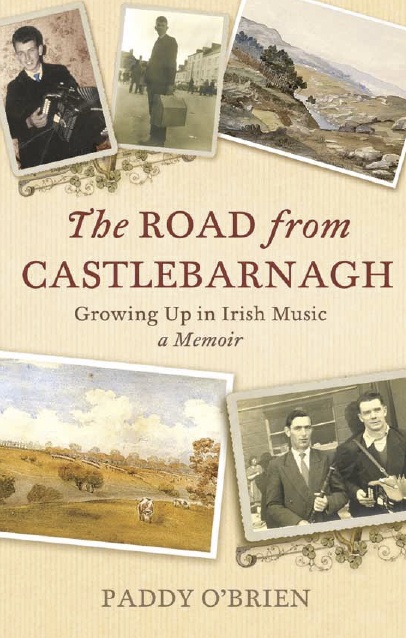
Paddy’s long awaited musical memoir, THE ROAD FROM CASTLEBARNAGH, was released in October 2012 by Orpen Press in Ireland! Dufour Editions is distributing the book in North America, and it's now available from bookstores in the US (and to booksellers via Ingram — ISBN 978-1871305692).
You can also order here at Paddy’s Online Shop, and at all good bookstores in Ireland and the US, as well as through Amazon.co.uk, and Amazon.com, Barnes & Noble, from your favorite indie booksellers through IndieBound, and directly from Orpen Press.
THE ROAD FROM CASTLEBARNAGH is also available as an e-book from Orpen Press, in Kindle editions from Amazon.com and Amazon.co.uk, from iTunes, Barnes & Noble’s Nook, and via the independent booksellers' e-book format, Kobo.
SYNOPSIS: THE ROAD FROM CASTLEBARNAGH recounts the many adventures of Paddy O'Brien, Irish traditional musician, composer and collector, as a boy growing up more than half a century ago in the Midlands of Ireland. Paddy grew up in a small thatched house without running water or electricity, near the town of Daingean in County Offaly. It was a time when the social life in the Irish countryside often took place around the hearth fire, where stories were told and music was played. Paddy relates stories of thatching the house with his father, the ringing of the big pig, the boys' National School, turf cutting, a ghostly confrontation and the Banshee. His colourful autobiography introduces readers to the many interesting characters who shaped his own perception of Irish life and culture. Written in an easy-going, storytelling style, this book is for anyone interested in Irish traditional music and life in rural Ireland in the mid-20th century. There's a particular emphasis on Paddy's own development as a traditional musician and the experience of growing up within the music.
“A colourful and often compelling evocation of a life consumed by music, and by the sense of community that underscored it.” — Siobhán Long, IRISH TIMES, Dublin
“Written in lovely prose style, THE ROAD FROM CASTLEBARNAGH is a rewarding and highly recommended memoir about music and culture.” — Daniel Neely, THE IRISH ECHO, New York
“He is renowned today as a walking national treasury of over 3,000 melodies (along with any details he retains of their provenance and stories connected with them); he is also a prizewinning master of the two-row button accordion and an award-winning composer of over fifty new tunes, many featuring delightfully inventive turns and surprises. He is a fine writer of clear prose too, here casting his memory back more than five decades—and a cross the wide Atlantic Ocean...” — Syd Bluett, BOOKS IRELAND, Dublin
“O’Brien’s graceful, lyrical prose flows with a spring-fed stream’s purity, and his natural gift as a storyteller lilts along with the cadence, mystery and depth of one of his jigs or reels.” — MinnPost.com, Minneapolis
“…A rare gift… All Irish musicians, and anyone interested in the passing of old ways into new times, will find this memoir rewarding and worthwhile.” — Sherry Ladig, Irish Music & Dance Association, Saint Paul
“His memory is spectacular, his writing lovely, and it's great fun to imagine the vastly different world he describes in this book.” — Nathan Gourley, Irish traditional fiddle player on Amazon.com
Here’s a bit from one of the first chapters:
HAIRPINS AND COMBS
It was early spring in 1953 when I was sent outside in search of sticks or “firan,” as my father would say. This was firewood that had to be gathered and brought home to our kitchen to dry by the fire. Much of it was small twigs, which were very useful for kindling and of enormous help in starting a fire during early morning hours. It was usually my job to keep my father supplied with enough of this “firan” and any neglect meant an uncomfortable scolding.
One afternoon, when returning with an armful of kindling, I spotted a black donkey and cart outside our gate. The cart had no sideboards. A sackful of something lay near its tail-end, and several implements for farm work lay on the floor of the cart—pitchforks, spades, shovels and iron picks with their separate handles made of fresh ash. The man in charge was tying his donkey to our iron gate beside the road. Going back behind his cart, he unloaded a sackful of curios and hoisted it onto his shoulder. As I neared the door of our house, he beat me to it and was already talking to my mother.
“Well, Jim,” she says, “Come in, and let’s see what you have.”
I followed him inside and put my own load in the corner by the fire. He unloaded his sack onto the cement floor and opening its neck, revealed a bunch of articles I recognized as mousetraps, spools of thread, and rat-traps. But when he turned his sack upside down, I was astounded at the extent of his other items: hairpins, brushes, combs, candles, Clark’s tin whistles, rings for ringing the snouts of pigs, rattles for small children, shoelaces and mouth organs. I ran to my mother when I saw the mouth organs. “Mammy, Mammy, get me one, get me one!” I begged. And she did! For one shilling. And so began my musical career.
She bought a few other accoutrements as well, candles and Saint Patrick’s Day badges. When the peddler began his departure, I saw that he was a tall, lanky man with a peaked cap and he was wearing a long gray tweed topcoat. Some of its coat buttons were missing and it was held together at the waist by binding twine instead of a belt. He had a hooked nose and small dark eyes almost like an eel. His Adam’s apple stuck out in his neck and his hands had very long fingernails, which my mother liked, because this suggested he had an even temper. This is considered an old wives’ tale in today’s world and my mother had a store of them. She was later put on the defensive regarding the length of the peddler’s nails after he untied his donkey and climbed onto the front of the cart. With the reins in each hand, he gave them a short tug. “Gid up there, Bosco,” he shouted at the donkey. The donkey stood motionless. The peddler roared and shouted, “Gid up! Gid up!” But Bosco the donkey stood still. Jim the peddler reached back behind and grabbed a pick handle. “Now,” he says, “See what you think of this, you miserable bag of fuckin’ glue!” He began beating the donkey’s rump and was beginning to sweat himself into a frenzy when my mother came running up to the gate.
“Stop! Stop!” she yelled at the peddler. “Jim, I’m surprised at you. This is cruelty. Stop it!” She had a basin full of chopped turnips which she was preparing for dinner. “Let me try a little bit of kindness; it goes a long way.” She stepped outside the gate and pushed the basin of turnips under the donkey’s mouth.
I was standing nearby and began testing the mouth organ, hooting it and running it back and forth against my mouth. Bosco was probing at the turnips but then he turned his head in my direction. His ears stood at attention. In two seconds, he began to plunge forward, and jerking the cart up the small hill, he began running. The peddler’s cap tumbled from his head when he was suddenly pulled forward. I was still puffing at my mouth organ, a ten-year-old boy who didn’t know that his “music” had frightened a dumb animal out of his wits. I continued to blow into my instrument and walking up onto the roadside I was just in time to see the peddler and his donkey and cart disappear around a turn in the road. That was the last I ever saw of them. It was a story that was told over and over in front of many a hearth fire in our locality.

The following winter, we hosted a house dance and invited two accordion players and a fiddler to provide some music. My father said he would beat his tambourine. It was on a Sunday night and with our oil lamp turned up we added a couple of candles to give extra light in the kitchen. Sandwiches were made with sardines and ham. Armfuls of turf were stuffed into a bin and an extra kettle was brought along by one of my aunts. A tall, dark man with a brown hat played a Hohner Black Dot accordion. His name was Paddy McGrath and he was noted as a good player. A second accordion was a C#/D Paolo Soprani, a red-coloured one, played by Mick Hayes. The fiddler was a friend of our family, a very generous man and very shy. He was known to us children as Dinny. His last name was Doyle, and his place of abode was a half-mile north of our house beside the banks of the Grand Canal. I never heard him play by himself and didn’t know about him having a fiddle until that evening.
The three of them began playing together at about eight o’clock. I was sitting in my chosen spot in the corner by the fire. It was a good vantage point and I felt awfully happy as I waited for the proceedings to develop. My sister Moira was sitting near me and I could see her eyes open wider as the music was played. We had never heard musicians playing together like this and were convinced afterwards that it was better than the wireless. There were fourteen people not counting my parents and the three musicians and as the music was played four couples began waltzing around the floor. My sister and I were watching our aunts and their men laughing and joking. Moira and I thought they looked funny on account of not seeing them dance before. Soon other people took to the floor and in a short time the kitchen was crowded with people.
Later on in the evening, tea and sandwiches were provided and this also gave the musicians a break but it didn’t last very long. Then they began again with another waltz and five couples took the floor while others were calling for a half set. Our kitchen was a small space and could only accommodate five or six couples at one time. However everyone had a mighty time and the highlight of the evening were the half sets danced to reels or polkas. These were my favourites because of the tunes and the basket swinging.
Tom Byrne loved to basket swing, which was a group of two fellows and two women, swinging with arms entwined about one another in a tight circle. Tom would propel the swing until it went out of time with the music and one or two people would become dizzy and disconnect from the circle and fall away against the wall. Tom himself lost his balance and fell against the dresser, almost knocking over a number of my mother’s wedding plates. When the music stopped, my father told everyone to keep calm and no unnecessary basket swinging during any of the sets. It was common in those days to remind dancers about unruly basket swinging because it ruined the continuity of the dance. When it got out of hand, it meant that women would scream and lose their feet on the floor and would be lifted and left hanging out of the bunch as it spun around and around. It reminded me of the swinging chairs at a visiting carnival that also produced high-pitched screams from young ladies.
During a break, a few bottles of porter were produced from somewhere. The musicians were the ones to get the first round and it energised them greatly. Paddy McGrath removed his hat because he was sweating. Mick Hayes followed suit and turning towards them I saw the sweat on their faces. Paddy reached over to me and gave me his hat. This made me feel important, and as a kindly gesture, I held his headwear close to the fire for drying. More dancing continued with a highland fling and then another half set. I heard a lot of different tunes that I hadn’t heard before, “The Sally Gardens,” “The Salamanca Reel,” and “The Echo Hornpipe.” An all-time favourite of my father’s was also played with all of its four parts. It was a jig he drummed into my head for years afterwards. The name of “The Lark in the Morning” made me cringe for at least twenty years, until I eventually realized that the tune was a nice piece of music and very well composed.
Our house dance lasted until midnight when everyone began to leave and face the cold night on their bicycles. My sister and I had been escorted to bed an hour or so beforehand. I remember our mother tucking us in and reminding us to go to sleep. Meanwhile, the music carried on, and we could easily hear it through the wall between us and the kitchen. It was long after midnight when we finally fell asleep.
THE ROAD FROM CASTLEBARNAGH was published by Orpen Press in October 2012.
Book reviewers and media people interested in review copies should get in touch with Paddy directly via e-mail (PaddyOBrienBox@gmail.com), or contact publicists Peter O’Connell (Ireland) or Larisa Werstler (US) at:
Peter O’Connell Media
29/30 Dame St, Dublin 2, Ireland
Phone: + 353 (0)87 681 4499
email: peter@peteroconnellmedia.com
Larisa Werstler
Dufour Editions, 124 Byers Road, PO Box 7, Chester Springs, PA 19425
Phone: (610) 458-5005 / Fax: (610) 458-7103
email: factotum@dufoureditions.com
US-based booksellers wishing to carry the book should contact:
Ingram:
THE ROAD FROM CASTLEBARNAGH: Growing Up in Irish Music, A Memoir
by Paddy O'Brien
ISBN 978-1871305692
Or the US distributor, Dufour Editions:
info@dufoureditions.com
http://www.slirz.com/contact-us/
Poems ~ Traditional Musician Series
I've been inspired by musicians I've known over the years, and have ended up writing a series of poems—character portraits, really—about the people whose music influenced me so much, including people like Tommy Potts, Willie Clancy, Sonny Brogan, Seamus Ennis, Páidí Bán O Bríain, Micho Russell, Michael Dwyer, Sean Maguire, Tony MacMahon, Julia Clifford, John Kelly, Jack Dolan, Bill Harte, and a few others as well. Here's a sample...
Potts
 Thrown in amongst puzzled onlookers
He stroked and pulled and glided his bow
Head bent in total reverence to his vision of the spirit.
While listeners wondered about the strength of their praise
His swollen eyes let loose the tears of the forgotten dead
And then the rhythm and the lift
And the notes that broke the rules
Of conventional acceptance
And the humble loneliness of the crucified stranger
Leapt forth in freedom's ecstasy as Potts bent lower and lower
Caressing the sound of his unspeakable compassion.
And the tune was a happy tune
All naked and ready on the headland
But the gallant surprise of it all
Was the sadness and the pleading
That came again and again
For those of us who listened closer
When the sound-post trembled
To the music of Tommy Potts.
© Paddy O'Brien, April 1989
JULIA CLIFFORD (NEE MURPHY)
 She had an instinct like that of a mother
Who knew when to butter bread for her children
And when she bowed her fiddle
’Twas as if she was spreading
And pasting her notes of untamed nourishment
That satisfied those whose lust
For the polka dance
Brought them on dark nights
Across the rocks and meadows of Kerry
To where Julia and brother Denis
Would sit and play
And brother Denis would turn to her
With a knowing smile
And say “Do you remember this?”
And with quiet deliberance
She would edge into the reckoning
Of the last portion of the set
While outside in the night
Lonesome moonlight made shadows
That unnerved sleepless dogs
Whose barks were outclassed
By the constant din of adventure
That came from within the cottage
And men and women were stamping and shouting
And making sport of a neighbor’s request
As Julia moved her head at an angle
That brought her into
Closer agreement with her fiddle
And then she was swaying her head
In gentle movements from side to side
As she became transfixed with the elusive
But at last her servile memory began to grasp
At what had almost escaped her
After a year in London
And now she was beginning
To govern it with pride
As her bow took to the path of sweeping
And cutting into unused resin
And brother Denis eyed her again
Across his unfiddled shoulder
It was the glad eye of a man
Who knew the benefit of catching a trout
On the wrong side of a walled domain
Where peasants daren’t go
And his mustering thoughts became clouded
By the sight of a drink
That was being pushed into Julia’s hand
As she in polite consentment
Rested her fiddle on the lap
Of her long speckled dress
And as brother Denis lifted his glass
Julia Murphy lowered her head
In a vain attempt to conceal
Her bashful giggling
And raising her own glass
She became alive to the emotion
Of her homecoming
As she drank to the unshaven men
Who came from the bogs to meet her
And to the women whose churns
Held the broken clusters of white butter
That strengthened her will
When gravelled roads prodded
Her bare feet as a child
Of Kerry evenings after school.
© Paddy O'Brien, June 1989